By Barry Kenyon

Anything and everything about Thailand
Locked
User avatar
Jun
Posts: 2583
Joined: Mon Jul 10, 2023 8:43 pm
Has thanked: 398 times
Been thanked: 260 times

Re: By Barry Kenyon

Post by Jun »

Barry Kenyon wrote: Sat Aug 02, 2025 9:45 am Jomtien, by contrast, is deprived but does include Masala Twist, particularly popular with northern Brits, and the elegant Indian by Nature on Thappraya Road since 2004.
Jomtien also has "Hot Curry Indian Food", in Rompho.

Where Jomtien is deprived is with shopping. No Bootes, no Watsons, only mickey mouse supermarkets etc. I can't even buy a litre of UHT milk in Jomtien.

As for Prague, well he has severely exaggerated the number of Indian restaurants.
User avatar
Gaybutton
Posts: 24327
Joined: Sat Jul 31, 2010 11:21 am
Location: Thailand
Has thanked: 3 times
Been thanked: 1671 times

Re: By Barry Kenyon

Post by Gaybutton »

Upbeat expat news on foreign income taxes coming soon

By Barry Kenyon

August 5, 2025

According to a news report in Bangkok Post, the Thai Revenue Department (TRD) is finalizing legislation to appear in the Royal Gazette about foreign income transferred here. Director-general Pinsai Suraswadi said the new law will exempt from personal taxation resident individuals who bring foreign-sourced income into Thailand, provided that they transfer the cash in the calendar year, or the following successor year, in which it was earned.

Under current rules with effect from January 1 2024, foreign-sourced income is subject to personal income tax no matter when transferred after December 31 2023. That ruling by TRD, which applied to Thais or foreigners staying in Thailand six months or more in a calendar year created bombshell publicity amongst the expat community, especially retirees on pensions.

The prospective law, which could be made retrospective to January 2025 or even to January 2024, will be an amendment to current legislation and will require the approval only of the Cabinet and the Council of State. TRD reckons that the repatriation of an estimated 2 trillion baht tax-free cash from abroad, mostly from Thai nationals, will stimulate the economy.

Expats will remain on tenderhooks until the actual detail is in print. Will it apply to them or only to Thai passport holders (surely both)? Will ambiguous terms such as assessable income or liable income persist? Who precisely will need to register with TRD if they have not done so already?

The new law is not expected to expand TRD responsibility for worldwide income of resident tax payers. It is only income actually transferrred to Thailand which is the issue. On a separate matter, the Cabinet has approved a TRD proposal to exempt personal income tax on capital gains from the sale of digital assets or cryptocurrency effective for five years.
User avatar
Gaybutton
Posts: 24327
Joined: Sat Jul 31, 2010 11:21 am
Location: Thailand
Has thanked: 3 times
Been thanked: 1671 times

Re: By Barry Kenyon

Post by Gaybutton »

Need to fast-track work permits to ease Pattaya labour shortages

By Barry Kenyon

August 15, 2025

Local employers are asking the government to ease issues associated with labor permits for entrants from neighboring countries. Companies say that the process is convoluted and can even take several months, leading to some economic migrants being illegally and riskily employed.

The recent exodus of Cambodian workers from the Pattaya area (at the behest of Phnom Penh authorities) has caused more shortages concern, especially as international tourist numbers are picking up. For example, Japanese numbers have surged by 86 percent in recent weeks according to deputy government spokesperson Sasikarn Watthanachan.

Most foreign workers are from Myanmar, Cambodia and Laos under special MOU (Memorandum of Understanding) agreements with Thai authorities in 2017. They work in construction, retail, factories, farming, fishing and hospitality. Contracts typically last for two years, similarly extendable, although young males from Myanmar cannot return home to visit relatives as they risk conscription into the junta army.

Jessataporn Bunnag, director of the Foreign Workers Employment Agency located next to the Jomtien headquarters of Chonburi immigration police, said, “There is a general shortage of immigrant labor locally in all sectors. We can register new arrivals quickly, but the award of labour permits is a slow bureaucracy at the Department of Employment.”

Thai ministers have now called for immigrant labour to be recruited from “new” countries such as Indonesia and Sri Lanka to address the issue. But Mr Bunnag pointed out there is no relevant MOU to deal with all the details including wages, hospital cover and associated civil rights.

He said, “Without a specific MOU or Cabinet resolution, such immigrants would need a non-immigrant “B” visa and an employer here in Thailand. This is the system well-known to professional expats from the UK or the US and unsuitable for local-hire labourers. What we need is a fast-track bureaucracy to address quickly actual needs in the market place.”

A spokesman for the employment ministry said, “There are around 2.5 million authorized local foreign workers in Thailand, with about one third in the Chonburi (including Pattaya) area.” Many observers say that the large number of undocumented workers could double that total.

https://www.pattayamail.com/latestnews/ ... ges-514229
Dodger
Posts: 3018
Joined: Sun Aug 01, 2010 2:58 am
Has thanked: 421 times
Been thanked: 711 times

Re: By Barry Kenyon

Post by Dodger »

If they estimate 5 million undocumented (illegal) immigrants are already working in Thailand why do they need anything?

It looks like Thailand's Tea Money Express is doing just fine.
User avatar
Gaybutton
Posts: 24327
Joined: Sat Jul 31, 2010 11:21 am
Location: Thailand
Has thanked: 3 times
Been thanked: 1671 times

Re: By Barry Kenyon

Post by Gaybutton »

Dodger wrote: Sat Aug 16, 2025 9:39 am If they estimate 5 million undocumented (illegal) immigrants are already working in Thailand why do they need anything?
I don't know how many workers are considered to be enough. Maybe 5 million sounds like a huge number, but perhaps it isn't enough.

I don't know how many fall under that MOU. In any case I would think the illegal workers would prefer to be documented legally rather than constantly having to play cat-and-mouse with immigration.
User avatar
Gaybutton
Posts: 24327
Joined: Sat Jul 31, 2010 11:21 am
Location: Thailand
Has thanked: 3 times
Been thanked: 1671 times

Re: By Barry Kenyon

Post by Gaybutton »

Thai banking issues leading to DTV’s increasing popularity

By Barry Kenyon

August 16, 2025

The crackdown on tourists vainly trying to open Thai bank accounts has resulted in a surge of applications for the Destination Thailand Visa. That’s according to visa officers in Thai embassies, especially in nearby countries such as Laos and the Philippines. Although no regular government figures are published, over 120,000 DTVs have been issued by about 70 Thai diplomatic posts abroad in the first year of operation.

A key attraction of DTV is that applicants do not need a Thai bank account to show the liquid asset bond of 500,000 baht (US$ 16,000) since financial institutions abroad are acceptable depositaries. That’s in stark contrast to the annual extension of stay based on retirement or marriage to a Thai national which insists on the 800,000/400,000 baht bond being lodged specifically in a Thai bank. It is currently virtually impossible for tourists to open a Thai bank account as the major institutions try to clean out improper or mule accounts.

Thai immigration lawyer Jessataporn Bunnag said, “The scope of DTV is broad enough to include many who find the retirement visa rules too difficult. Apart from remote workers or digital nomads working for overseas companies, DTV also encompasses expats with families, adult learners and even medical tourists.” He explained that, contrary to popular belief, most DTV holders are not digital nomads, but now include large numbers of retirees and independent travellers who fit into another category.

An attraction of DTV is that medical insurance is not required for registration. Some (not all) retiree or similar visas need inpatient cover of varying amounts from specified Thai companies. Charles Weston, manager of Welcome to Thailand, said that the five-years multi-entry DTV did not require annual re-registration and awarded a maximum of 180 days per visit. “You don’t have to worry about re-entry permits or even having to show your bank account every year,” he concluded.

Immigration gurus do admit there are a few downsides to DTV. Tourist visa holders don’t get five years when they renew their driving licences and will have to be content with 24 months. They may be refused a traditional Thai bank account on a continuing basis and will need alternative international routes to fund themselves. The visa can be obtained only at a Thai embassy abroad (not at Thai immigration) and the waiting time can be a few days or a few weeks. It’s best to find out the required documentation well in advance and to choose your destination with care.

There was concern earlier this year that the DTV may entrap holders into paying personal income tax if they remained here more than 180 days in a calendar year. However, the Thai finance ministry recently claimed that income transmitted to Thailand would be tax-free if sent in the same, or next, tax year in which it was earned. However, such a decision requires ratification from the Cabinet and the Council of State, whilst avoiding the need for routine parliamentary approval. The hope is that any amendment to financial regulations would be back-dated.

DTV is an activity-based visa so applicants need to have a framework reason. But it is essentially a tourist visa and virtually all the documentary scrutiny is at the application stage abroad. Most holders report on Facebook chats that, as long as they leave the country within the 180 days limit, the return will be trouble-free at immigration check points. It’s surely a good deal.

https://www.pattayamail.com/latestnews/ ... ity-514344
User avatar
Jun
Posts: 2583
Joined: Mon Jul 10, 2023 8:43 pm
Has thanked: 398 times
Been thanked: 260 times

Re: By Barry Kenyon

Post by Jun »

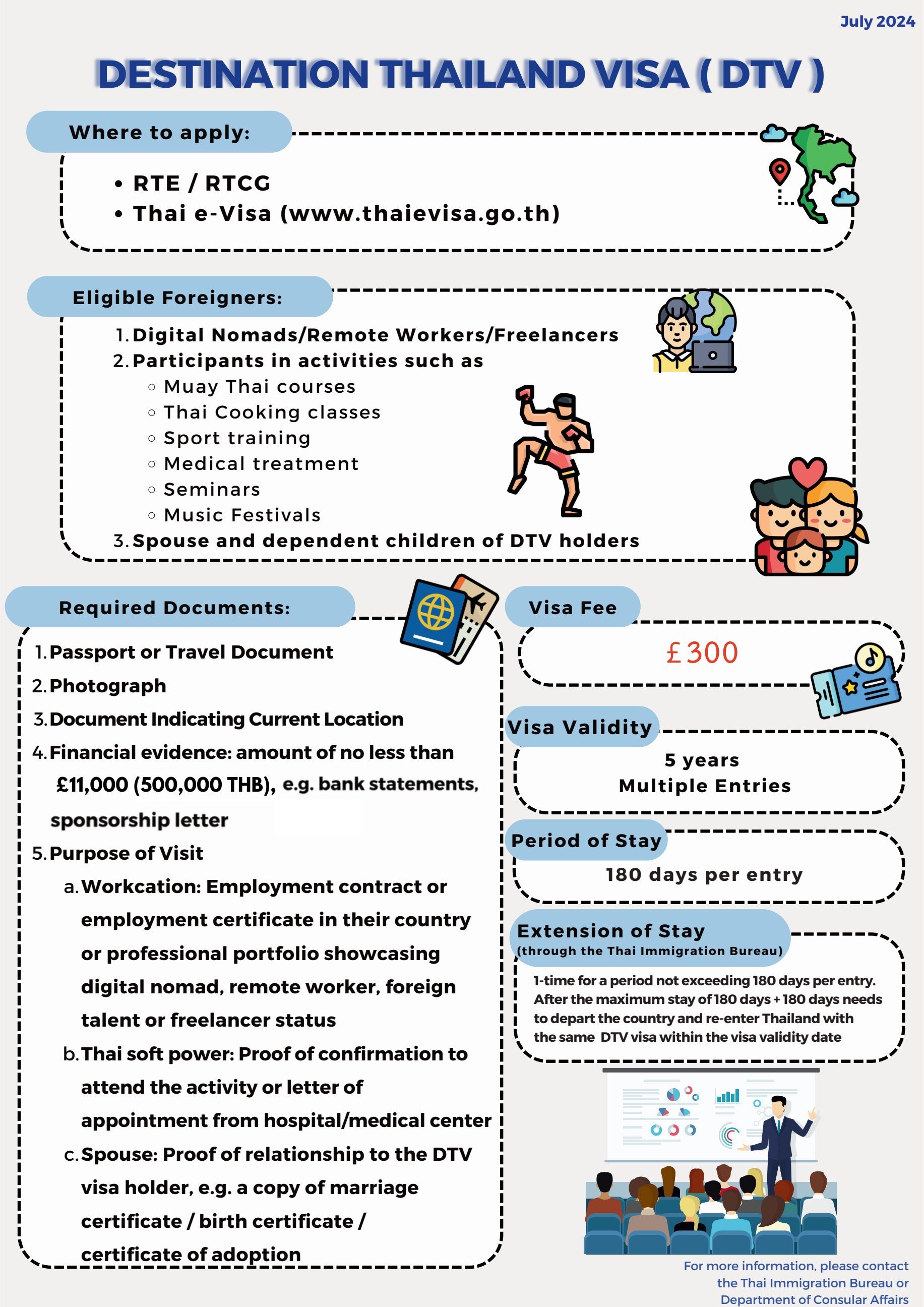
Well here's the summary (picture below).

What it doesn't tell us is what other hurdles we have to jump through during the 5 years.
(i) Do we need to report to immigration ?
(ii) Is anything else required to maintain it for 5 years ?
(iii) Do we need idiotic re-entry permits ?


The other question is how to qualify
1 Me researching stockmarket investments & making the occasional trade would bring in at least as much money as some of these other bullshit digital nomad jobs, but how do I prove that ?
2 There is the medical treatment option. I could book a medical, but exactly how much medical treatment are they looking for to issue a 5 year visa ?
3 Since cooking classes are eligible, how about language classes ?


Image
User avatar
Gaybutton
Posts: 24327
Joined: Sat Jul 31, 2010 11:21 am
Location: Thailand
Has thanked: 3 times
Been thanked: 1671 times

Re: By Barry Kenyon

Post by Gaybutton »

British police extend to Thailand their drugs warning campaign

By Barry Kenyon

August 24, 2025

The UK Border Agency is expanding Operation Karetu beyond the Mediterranean where numerous British youngsters have been exploited economically by criminal gangs. Now police want to campaign more effectively about Thailand, a tempting destination for young people seeking free vacations or cash rewards for becoming illegal drug mules.

The Sun, a popular British daily newspaper, wrote that “baby-faced” Brits departing on their first foreign holiday abroad were being advised to be ultra-careful by Border Agency officers on duty at principal British airports. Around 1,000 Brits have been arrested for drugs offences in the past year, mostly for trying to sneak back cannabis. Most were exposed on their return at a British airport. But Prisoners Abroad estimates worldwide there are at least 1,800 Brits in jail abroad, mostly on drugs charges.

Thai immigration deputy commissioner police major general Nattakorn Praphayon said there were five principal sources for the arrest of drug transporters. Some Thai provinces, such as the island of Koh Samui with its ideal climate, had sprawling farms rich in high-grade cannabis. Several dozen smugglers, including a large group of Brits, had been arrested before they could board a plane.

Bangkok’s international airports are a second hotspot for attempted cannabis exports. The Thai Narcotics Control Board points out that possession of cannabis is not currently an offence as a long-promised revisionary law has not yet been passed by the Thai parliament. However, it is an offence to export without a company business licence vetted by several government departments and Thai customs. Some drugs mules have only been fined for export bureaucracy failure and their illegal goods confiscated before being allowed to board a flight, though not necessarily the one they had booked.

A third group are those who do not return directly to UK but make a transit stop in a third country. These cases are the most publicized and include Bella Culley and Charlotte May Lee, in Georgia and Sri Lanka respectively, who are both caught up in lengthy pre-trial investigations without bail. The penalties in these stopover countries can lead to years of prison time or even the threat of the death penalty.

The fourth miscellany are those smugglers who make it back to UK but are arrested at airports there: the largest single group. Depending on how big the haul is in suitcases, a two-year jail sentence is to be routinely expected. A fifth way, now much less popular because of improved cooperation between Thai and British authorities is parcel post without a mule. Many believe that enhanced parcel inspection is the main reason for the rise in the use of mules.

Senior Border Force officer Louise Deakin said, “In Thailand especially, naïve young travellers are at high risk of being approached by gangs who offer rewards in return for carrying a couple of suitcases back to UK.” She added that many mules were actually recruited whilst still in UK, via Instagram, Tik Tok or other social media apps. But Thai police point to many cases, such as Culley and May, where Bangkok-based gangs preyed upon Brits in person, assuring them that there was no danger of being caught. The huge profits to be enjoyed by the cartels, at least 3,000 percent based on street pricing, mean that muling won’t be going away any time soon.

https://www.pattayamail.com/latestnews/ ... ign-515440
User avatar
Gaybutton
Posts: 24327
Joined: Sat Jul 31, 2010 11:21 am
Location: Thailand
Has thanked: 3 times
Been thanked: 1671 times

Re: By Barry Kenyon

Post by Gaybutton »

For me, despite making things tougher, it's far more tough for new retirees and those contemplating retirement in Thailand than it is for retirees already living for years in Thailand, especially for those of us holding the "O" retirement visa rather than the "O-A".

For me, despite all the changes over the years, almost nothing has changed. In some respects a few things have actually improved. I very much like being able to pay via Prompt Pay rather than having to carry around a lot of cash. And now, nearly everything can be paid that way. I don't even have to leave the house anymore to pay my bills.

Immigration has become far more inconvenient, but as long as I can do my annual retirement visa extension, I have no serious problem living with the rest of it. And while I think the 90-day address reports are ridiculous, at least most (but not all) of the time I can do it online rather than having to trek to immigration.

The only thing I seriously dislike is the possibility of being forced into cryptocurrency, which I know absolutely nothing about and don't want to have to deal with it. But I'll worry about it if I'm ever forced to get into it.

I still feel just as welcomed as ever.
________________________________________________

Expats disagree whether Pattaya still welcomes retirees

By Barry Kenyon

August 26, 2025

Just about everyone agrees Pattaya is changing fast, but there’s no consensus about how. To many YouTubers and their cell phones, it’s all about gogo clubs changing hands for exorbitant sums or the shock of finding a real transvestite pub in the heart of Soi Pothole. Facebook still hosts umpteen chats about where to find the best breakfast or whether mushy peas should be present on a genuine plate of fish and chips. It’s obvious that many retirees still live in a comfort bubble: yes, Pattaya has gotten more expensive with awful traffic, but it’s really the same underneath.

But others warn us that the writing is on the wall. In a series of real-time articles, lengthy expat Tom Tuohy has explained Pattaya’s (and Thailand’s) vanishing past. It’s no longer the simplistic paradise of bar girls, cash under the table and visa loopholes. The government is now pushing for serious visa reform, digital IDs, blockchain financial tracking and even cryptocurrency. The post-war Bubble retirees – 30, 20 or even 10 years ago – had just assumed that retirees were the key to Sin City’s future. Time for a rethink.

Pattaya has taken some particularly hard knocks. Banks here have been hostile towards tourists trying to open bank accounts. There was even a 24-hours rumor that retirees and others with annual extensions of stay would receive only a two years driving licence instead of the customary five. Retirees relying on visa companies to boost bank accounts for a longstay renewal have been warned this year that the ploy isn’t going to work in future. Digital photos and biometrics are now invading state bureaucracies and the banking sector. Paying for favors under the table won’t work like in the past.

And now even Pattaya is slowly moving towards a cash-free status. Local DHL courier services and some Starbucks locations have actually banned physical cash payments. Many street traders now have their QR code prominently displayed on their food carts. Meanwhile online banks, neobanks, digital wallets and peer-to-peer apps such as PayPal and Venmo are fulfilling many financial needs and bypassing traditional banking barriers.

Benjamin Hart, an American attorney and Thai citizen, in his insightful and frank videos has suggested that some of the blame lies with the current Thai government which seems to take too much notice of the World Economic Forum, a clique of elitist Euro socialists and totalitarians putting forth a global agenda of wealth distribution imposed by technology. His cited examples include proposed negative income tax, complex banking rules and increasing data-collection surveillance of the general public, including foreigners. Hart hopes that if the current Thai government falls in parliament, a more sensible administration will take over.

What has changed Pattaya is mass tourism, slick marketing (including booking apps and digital itineraries) and gentrification leading to the collapse of communities and the advent of the concrete jungle so familiar today. Whether retirees fit into the new scenario depends on a host of factors, not least their ability to accept new technologies which remove their privacy and, of course, their financial and wealth clout. Thailand makes no secret of its preference for rich foreigners. Columnist Bernard Trink (I Don’t Give A Hoot) wrote 20 years ago in Bangkok Post that the best summing up of Pattaya was the title of the musical hit Hey Big Spender. Perhaps Sin City hasn’t changed that much after all.

https://www.pattayamail.com/latestnews/ ... ees-515920
User avatar
Jun
Posts: 2583
Joined: Mon Jul 10, 2023 8:43 pm
Has thanked: 398 times
Been thanked: 260 times

Re: By Barry Kenyon

Post by Jun »

There's more substance & relevance to your comments than those of Barry Kenyon.

He's not added much in this instance & seems to have missed out on the real issues with the Thai government.
Also it's hard to see much of a change in government. Currently, they seem to have a sham election, followed by military selection of the government. What's next ? A different military selection, or full military government ?
Locked